Introduction
위치 | 서울특별시 구로구
용도 | 문화공간
Location | Guro-gu, Seoul, Republic of Korea
Program | Cultural space
Agenda
“공간과 경계”, 그리고 단절에 대한 지속적인 성찰은 그 근원을 통찰하고 수용하는 데서 비롯된다. 이는 단순한 물리적 실체를 넘어 인간 심리의 심연, 사회 구조의 복잡성, 그리고 관계의 본질까지 아우르는 깊은 사유를 요구한다. 때로는 불편한 경계일수도 있지만 그 간극을 해소하고 손을 내밀려는 노력을 기울일 때 우리는 비로소 단절된 세상 속에서 함께 공존하며 의미 있는 울림을 만들어낼 수 있을 것이다. 이 프로젝트는 그 믿음에서 시작한다.
Our ongoing reflection on “Space and Boundaries” and on disconnection, starts from insightfully understanding and accepting its origins. This requires deep consideration beyond the physical, delving into psychology, social structures, and our connections.Though some boundaries may be difficult, only by persistently working to close these divides and extend a hand can we truly coexist in a fragmented world and forge impactful echoes. This project is founded on that belief.

우리가 살아가는 도시는 다양한 영역들이 공존하며 끊임없이 변화하는 유기체와 같다. 마치 악기들이 모여 하나의 아름다운 교향곡을 연주하듯, 도시를 구성하는 서로 다른 기능과 성격의 공간들은 때로는 부딪히고 갈등하지만, 서로에게 영향을 주며 새로운 가능성을 만들어 낼 수 있으며 이러한 도시의 역동성을 ‘공명’이라는 개념으로 이해해 볼 수 있다. 개별적인 공간들이 서로 단절되어 존재할 때 그 가치는 제한적이지만, 경계를 허물고 소통하며 공명하는 순간, 그 이상의 잠재력을 발견하게 된다. 우리는 이런 공명을 일으키기 위해서 지속적인 관심과 끊임없는 노력을 이어 나가야 한다. 그리고 구로차량기지는 현재 이러한 노력이 필요하다.

1974년 8월 15일, 수도권 전철의 첫 지하철인 1호선 개통과 함께 문을 연 구로차량기지는 지난 반세기 동안 수도권 전철의 ‘혈맥’이자 서울이라는 도시의 ‘심장’ 역할을 충실히 수행해 왔다. 하지만 도시가 확장됨에 따라 구로차량기지는 구로를 가르는 경계선으로 작용하며, 지상으로 노출된 지하철 1호선 선로와 함께 두 지역 간 교통 및 소통을 저해하는 기피 시설로 인식되고 있다. 이에 지난 20년간 기지 이전 논의가 계속되었지만, 그 마저도 쉽지 않은 것이 현실이다. 단절된 구로에 공명을 일으키기 위해서 우리는 어떤 노력을 할 수 있을까 고민해볼 때이다.
Our cities are like living organisms, with diverse areas constantly changing and interacting. Similar to how instruments form a symphony, a city’s various spaces, despite occasional conflict, influence each other to create new possibilities. We can understand this urban dynamism as resonance. Individual spaces have limited value in isolation. But by breaking down boundaries and fostering communication, they resonate and unlock greater potential. We need continuous effort to create this resonance, and the Guro Rail Depot is a prime example of where such effort is currently needed. The Guro Rail Depot, opened on August 15, 1974, with Seoul Subway Line 1, has been the metropolitan subway’s lifeline and Seoul’s heart for half a century. Yet, with urban expansion, it now divides Guro, its exposed Line 1 tracks hindering traffic and communication, and is seen as an undesirable facility. Despite two decades of relocation discussions, moving it remains challenging. It’s time to consider how we can bring resonance to a disconnected Guro.

구로차량기지는 현재 고층형 주거지역과 저층형 주거지역의 경계로써 작용하고 있다. 더불어 서울권에 위치한 구로 지역 일대의 중심에 위치하고 있다는 점에서 가지는 잠재력은 강력하지만 구로가 위치한 서울 서남권은 총 465개로 모든 지역 중에서 가장 적은 문화시설을 보유하고 있다. 그마저도 대부분이 작은 도서관으로 구성되어 있어 시민들에게 새로운 공명의 기회를 제공할 필요가 있다고 생각한다. 차량기지에 대한 대한민국의 개발 방식의 새로운 고민을 시도한다. 최근까지도 차량기지에 대한 개방 방식은 넓은 면적을 효율적으로 활용하려는 방안에 초점이 맞춰져 있어 주거 및 상업 시설 중심으로 개발되는 경향이 있다. 이러한 방식은 토지 이용률을 극대화하고 이익을 창출할 수 있지만 도시 내 부족한 시민들을 위한 공유 공간에 대한 아쉬움을 남기기도 했다.
The Guro Rail Depot currently divides high-rise and low-rise residential zones. Despite its strong potential due to its central location in Seoul’s Guro area, Southwestern Seoul has the fewest cultural facilities (only 465), mostly small libraries. This highlights a critical need to provide citizens with new opportunities for cultural resonance. We’re rethinking South Korea’s approach to developing rail depots. Until recently, the focus has been on efficiently utilizing these large areas, leading to developments primarily centered on residential and commercial facilities. While this maximizes land use and generates profit, it often leaves a void in terms of much-needed public and shared spaces within the city.

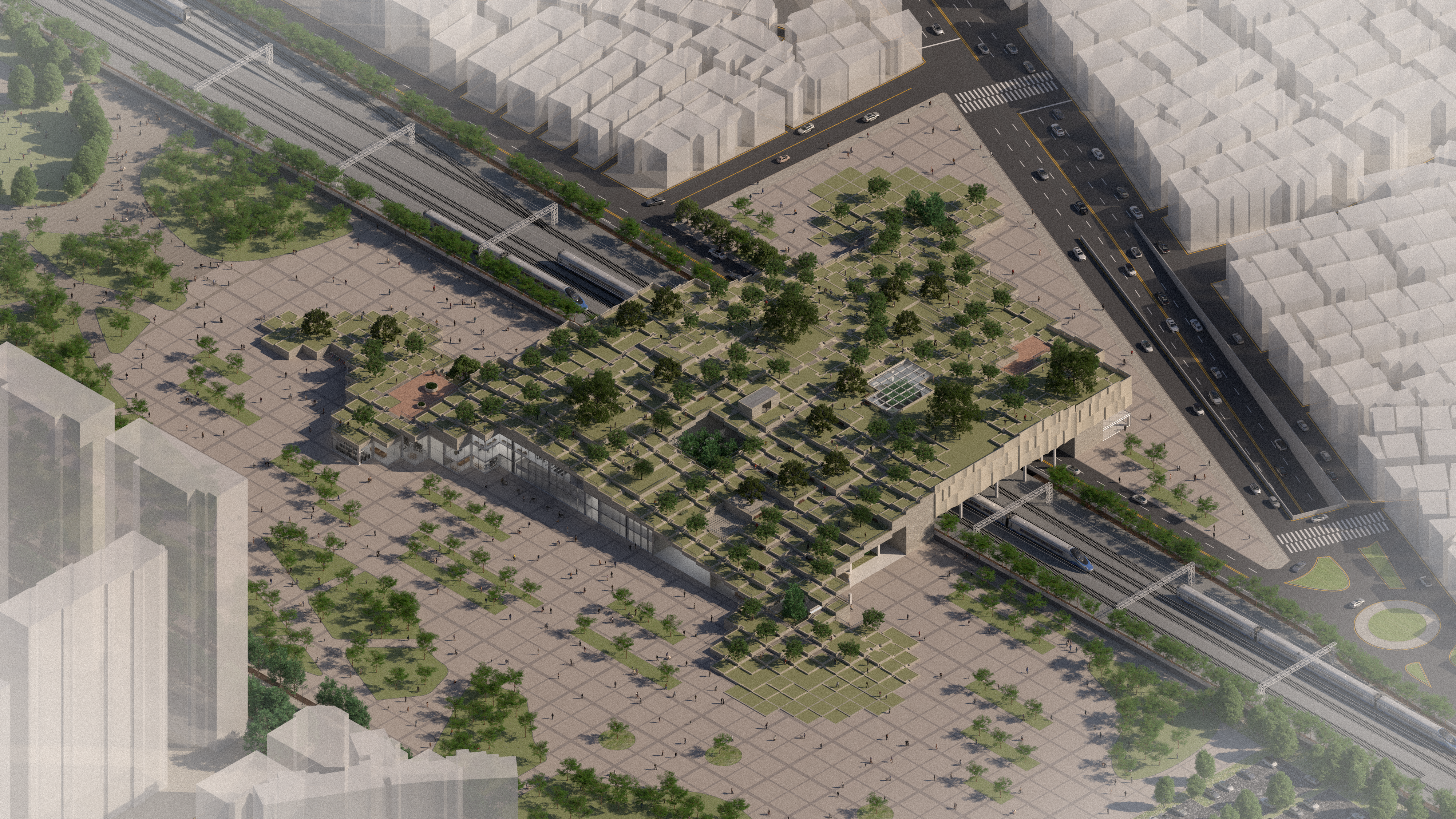
이 프로젝트는 이러한 고민의 연장선이다. 이는 오랜 시간 동안 지역을 단절시키는 요소로 작용했던 구로차량기지가 연결의 중심에 위치하며 시민들이 자유롭게 왕래하며 소통할 수 있는 공간으로써 발전할 수 있는 가능성이다. 차량기지 부지의 지하화가 문제 해결의 시작점이다. 이후 수평적인 공원의 활성화를 통해 사람들이 모일 수 있는 공간을 계획하고 1호선에 대한 지하화는 현실적으로 불가능하기에 추가적인 부지를 설정함으로써 두 영역이 연결될 수 있는 계획안을 구상하였다. “경계 공명”은 이연결을 위한 공간에 초점을 맞추어 단절을 해소하고 소통의 공간으로써 시민들의 새로운 경험의 장을 제안한다.
This project is an extension of that very concern. It represents the potential for the Guro Rail Depot, which has long been a divisive element, to become a central hub for connection, evolving into a space where citizens can freely move and interact. Undergrounding the rail depot site is the first step. Then, we’ll create a vibrant horizontal park to gather people. As Line 1 can’t be undergrounded, we’ll need additional land to connect the two areas. This project focuses on this connecting space, resolving the disconnection and becoming a new, engaging area for citizens to communicate and experience.

사이트를 단면과 평면을 기준으로 연결하는 것을 생각했을 때 시작 시점으로부터 점층적인 상승을 유도하여 사람들에게 완만한 언덕처럼 느껴지도록 한다. 더불어 연결과 함께 주민의 문화 활동에 필요한 여러 시설이 하부 공간을 구성하는 다기능적인(Multiple Function) 공간으로 계획한다. 벽돌 재료를 통해 5m x 5m 그리드를 기준으로 층층이 쌓여 갈 수 있는 모듈을 고안한다. 이 모듈들은 각각 300, 600, 900, 1200mm의 높이 간격을 기준으로 구성되며 각 모듈은 합쳐지거나 제외되어 다양한 공간으로 구현될 가능성을 지닌다. 이러한 시도는 사람들로 하여금 언덕 위의 공원으로 인식될 수 있도록 할 것이다.
To connect the site effectively in terms of both its sectional and planar aspects, the design aims for a progressive upward slope from the starting point, creating the sensation of a gentle incline for users. Concurrently, the space beneath this connection will be designed as a multifunctional area, accommodating various facilities essential for community cultural activities. The design proposes a modular system constructed from brick, conceived to be stacked within a 5m x 5m grid. These modules are structured with height intervals of 300mm, 600mm, and 900mm. Their flexibility lies in the ability to be combined or independently used, enabling a wide array of spatial configurations. The overall intent is to evoke the image of a park situated atop a hill.
Floor Plan


Section

Modeling


Maquette


