개요 Introduction
위치 ㅣ 경기도 양평군 양동면 삼산리
용도 ㅣ스튜디오
층수 ㅣ2F
Location ㅣSamsan-ri, Yangdong-myeon, Yangpyeong-gun, Gyeonggi-do, South Korea
Program ㅣ Studio
Floors ㅣ2F
Agenda
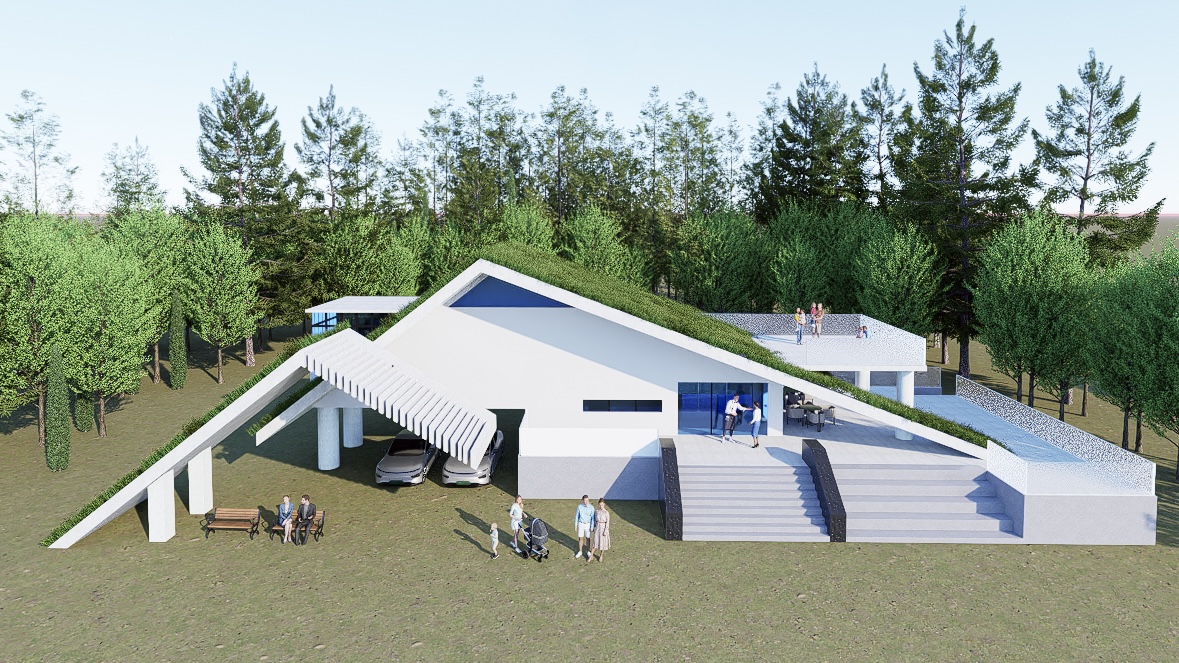
양평의 숲 속에 위치한 이 레스토랑은 식사를 위한 단일한 공간이 아니라, 자연을 통과하며 경험하는 하나의 공간적 여정으로 계획되었다. 건축은 대지 위에 놓인 오브제가 아니라 주변의 숲과 관계 맺으며 형성되는 구조로 설정되었고, 이를 통해 건축과 조경의 경계를 흐리고자 했다.
클라이언트는 요리를 결과가 아닌 과정으로 인식하는 이탈리아 셰프로, 이러한 태도는 공간 구성 방식에 직접적으로 반영되었다. 레스토랑은 하나의 밀폐된 홀 대신, 사용자가 이동하며 장면을 경험하는 공간의 시퀀스로 구성되었으며, 중앙에는 다이닝 공간과 스튜디오를 배치하고 그 주변으로 주방, 작업 공간, 숙소 등의 기능적 공간을 배치해 공공에서 사적으로 점진적으로 전이되는 구조를 형성한다.
프로젝트의 핵심 개념은 건물의 두 면을 정원적 공간으로 구성하는 ‘Two Garden Faces’이다. 이를 통해 내부 공간에서도 지속적으로 자연과 시각적·공간적 관계를 맺도록 하였고, 사용자는 건축 안에 있으면서도 자연 속에 머무는 감각을 유지하게 된다.
형태는 단순한 기본 매스에서 출발해 수직적 단면의 깊이를 도입하며 발전한다. 맞배지붕은 숲의 수직성과 리듬을 단순한 형식으로 받아들이는 동시에, 강한 단면을 통해 공간을 시퀀스로 조직하기 위한 장치로 선택되었다. 지붕은 선택적으로 덜어내어 정원적 조건을 형성하고, 이는 장식적 옥상이 아니라 대지의 숲이 건축 위로 연속되는 또 하나의 풍경으로 작동한다.
지붕을 관통하는 내부 공간은 지면의 숲과 지붕의 숲을 시각적·공간적으로 연결하며, 건축 전체를 하나의 숲의 단면처럼 인식하게 만든다. 1층은 마당과 연계된 공공적 다이닝 공간으로, 2층은 조망을 절제한 보다 사적인 공간으로 구성되어 자연과의 관계가 층위에 따라 달라지도록 계획되었다.
이 프로젝트는 자연을 배경으로 삼는 건축이 아니라,
자연의 구조와 감각이 공간 경험으로 번역되는 방식을 통해 건축 자체가 풍경의 일부로 작동하는 가능성을 제안한다.
The restaurant, located in the forests of Yangpyeong, was conceived not as a single enclosed dining space but as a spatial journey experienced through nature. Architecture here is not treated as an object placed upon the land, but as a structure formed in relationship with the surrounding forest, with the intention of blurring the boundaries between architecture and landscape.
The client is an Italian chef who perceives cooking not as a result but as a process, and this attitude is directly reflected in the spatial organization. Instead of a single enclosed hall, the restaurant is composed as a sequence of spaces where users move and encounter different scenes. At the center are the dining area and studio, surrounded by functional spaces such as the kitchen, work areas, and accommodations, creating a gradual transition from public to private.
The core concept of the project is “Two Garden Faces”, in which two sides of the building are designed as garden-like spaces. This ensures that the interior maintains a continuous visual and spatial relationship with nature, allowing users to feel as though they remain within the forest even while inside the architecture.
The form begins with a simple basic mass and evolves by introducing vertical sectional depth. The gable roof was chosen as a device to both embrace the verticality and rhythm of the forest in a simple form, and to organize the spatial sequence through a strong sectional profile. Portions of the roof are selectively removed to create garden conditions, functioning not as decorative rooftops but as an extension of the forest landscape continuing over the building.
The interior spaces that cut through the roof visually and spatially connect the forest on the ground with the forest on the roof, allowing the entire architecture to be perceived as a sectional fragment of the forest. The first floor is designed as a public dining space connected to the courtyard, while the second floor is composed as a more private area with restrained views, so that the relationship with nature changes according to level.
This project does not treat nature merely as a backdrop for architecture. Instead, it proposes the possibility of architecture itself functioning as part of the landscape, by translating the structures and sensations of nature into spatial experience.
Images


Maquette


Credit