Introduction
위치 | 경기도 성남시 분당구 탄천상로 95
용도 | 공동주택
대지 면적 | 9,947㎡
건축 면적 | 5,387㎡
층수 | B1F – 8F
Location | 95, Tancheonsang-ro, Bundang-gu, Seongnam-si, Gyeonggi-do, Republic of Korea
Program | Housing
Site Area | 9,947㎡
Building Area | 5,387㎡
Floor | B1F – 8F
Agenda
오지랖이 사라졌다. 지금 우리 사회에서는 오지랖이 불편하고 무례한 것으로 여겨진다. ‘선을 넘지 마세요’를 표방하는 시대, 도시 환경의 우리는 행여나 말 한 마디, 행동 하나가 괜한 오지랖으로 여겨질까 걱정하며, 더욱 남들의 사정에 관여하지 않게 되었다.
점점 의지하며 속마음을 터 놓을 곳이 없어 많은 사람들이 마음의 병을 앓고 살아간다. 우리가 힘을 얻고 의지하는 관계는 가족이나 친한 친구처럼 나의 일거수일투족을 알고 참견하는 사람들이다.
앞으로 우리 아이들이 살아갈 사회는 ‘다정한 무관심’의 사회가 아닌, ‘선한 오지랖’의 사회가 되어야 한다. 누군가의 돌봄 행동을, 친절함과 공감 능력을 ‘오지랖’이라고 손가락질 하지 않는 세상을 만들어야 한다.
천천히 느긋한 오지랖을 부리며 관계 맺는, 아이들을 위한 따스한 주거 커뮤니티의 공간을 제안한다.
Ohjirap(to wonder about others, to be nosy) has disappeared. In our society now, Ohjirap is considered inconvenient and rude. Living in an era that advocates ‘not crossing the line,’ our urban environment has made us increasingly hesitant to utter a single word or take even a single action, fearing that it might be deemed as unnecessary meddling. Consequently, we’ve become more reluctant to interfere in others’ affairs.
As people increasingly rely on themselves, many suffer from mental illness due to a lack of a place to confide their innermost thoughts. The relationships we rely on for strength are people who know my every move and meddle, such as family and close friends.
In the future, the society in which our children will live should not be a society of ‘kind indifference’, but a society of ‘good Ohjirap‘. We need to create a world that doesn’t point fingers at acts of care and kindness, nor label them as intrusive, but rather values them as expressions of compassion and empathy.
We propose a warm residential community space for children that builds relationships with slow and relaxed Ohjirap.
Concept

본디 오지랖의 뜻은 ‘겉옷의 앞자락’이다. 그렇다면 마을을 둘러싼 겹겹의 공간들은 도시, 그리고 건축에서의 오지랖으로 볼 수 있지 않을까?
개인과 도시 사이에는 여러 자락의 공간이 존재한다. 사적 영역으로부터 공적 영역까지, ‘선한 오지랖’의 확산을 위한 공간 전략을 소개한다.
Originally, the meaning of Ohjirap is ‘the front end of the outerwear’. If so, wouldn’t the layered spaces surrounding the village be seen as Ohjirap in city and architecture?
There are several spaces between individuals and cities. From the private to the public domain, it introduces a spatial strategy for the spread of ‘good Ohjirap‘.
Site

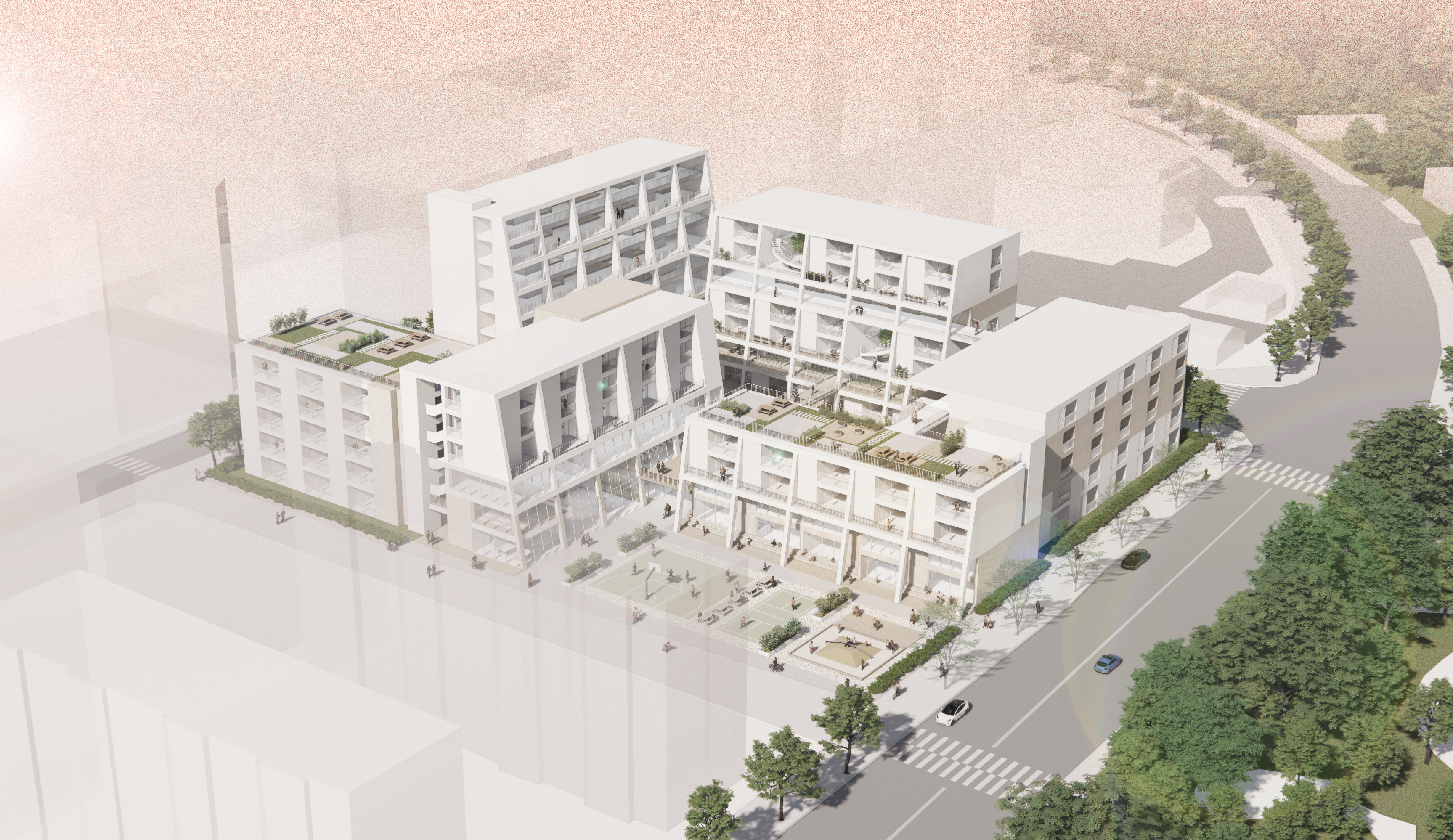
단지는 6개 동으로 구성되어 있으며, 동 사이의 마당은 주변의 맥락과 이어진다. 오리역으로부터 이어지는 입구는 진입마당으로, 공원으로 향하는 숲길과 면하는 마당은 체육 마당으로, 주동이 감싸는 중정은 아이들이 안전하게 뛰노는 놀이마당으로 구성했다.
It consists of six blocks, with courtyards connecting between each block to the surrounding context. The entrance from the Ori Station leads to an entry courtyard, while paths leading to the park form a forest courtyard, and facing yards become sports courts. The central courtyard embraced by the main block is designed as a playground where children can play safely.
Design
[마당] 일상이 아이들을 돌보는 공간

배치 : ‘프로그램이 아이들을 돌보는 것이 아닌, 일상이 아이들을 돌보아야 한다’는 개념에 입각하여 단지 내 공간의 얼개를 구성했다. 프로그램은 24/7 동안만 지속되지 않는다. 아이들이 필요로 하는 관심에는 낮밤이 없다. 단지 내 건물의 저층부를 특정 프로그램으로만 채워 넣는 것을 지양하고, 주거 유닛을 함께 배치하여 일상 속 느슨한 오지랖으로 둘러싸이는 마당을 지향한다.
규모 : 본 공동주택의 커뮤니티는 아이들을 중심으로 형성되고, 지속되는 것임을 전제로 한다. 따라서 단지 내 마당은 단일의 커다란 광장이 아닌, 아이들의 스케일에 맞춘 다수의 작은 마당을 필요로 한다. 마당은 주 동 매스의 배치에 의해, 그리고 각 동을 연결하는 브릿지에 의해 자연스럽게 분할된다.
성격 : 각 마당의 성격은 인접 매스의 저층부 프로그램과 연계되어 활용될 수 있도록 한다. 대지 경계부에 위치한 마당은 외부와 적극적으로 연계하고, 단지가 감싸는 중정형 마당은 외부로부터 적절히 차단되도록 그 위계 또한 고려하였다.
[Madang] A place where daily life takes care of children
Arrangement: The framework of the space in the complex was constructed based on the concept that ‘the daily life should take care of the children, not the program.’ The program does not last only 24/7. There is no day or night for the attention that children need. It avoids filling the lower floors of the complex with only specific programs, and aims for a yard surrounded by a loose Ohjirap in everyday life by arranging residential units together.
Scale: The community of this residential complex is built around and sustained by children. So, rather than a single large square, the courtyard within the complex necessitates several smaller courtyards tailored to children’s scale. These yards are naturally divided by the arrangement of the main building masses and bridges that connect each block.
Characteristics: The characteristics of each yard can be utilized in connection with the lower-rise program of the adjacent mass. The yard located at the boundary of the site is actively linked to the outside, and the hierarchy is also considered so that the middle-shaped yard surrounded by the complex is properly blocked from the outside.
[복도] 다양한 관계맺기의 매개 공간

중복도 : 복도를 가운데 두고 세대들이 마주하도록 배치하여 일상 속 자연스러운 관계맺기가 가능하도록 한다. 각 세대의 마루들을 엇갈리게 배치하여 직접적인 시선을 적절히 차단하고, 마루 앞 공간을 세대별로 확보한다. 각 층을 구성하는 유닛 타입은 적절히 혼합되어 주민들 간 다양한 교류가 이루어진다. 예컨대 조부모와 멀리 떨어져 살아 노인 세대를 자주 만날 기회가 없는 아이들은 이웃의 노인 부부를 일상 속에서 자주 마주치고, 교류 빈도가 늘어나면서 자연스럽게 예의범절과 그들의 지혜를 어깨 너머로 배울 수 있다.
편복도 : 세대 앞 넓은 복도 공간은 단순히 이동만을 위한 공용 공간이 아닌, 텃밭, 커뮤니티 라운지, 소규모 마당 등 주민들의 적극적 관계맺기를 장려하는 공간이 된다.
편복도와 중복도의 혼합 : 마당을 감싸는 주동의 입면이 복도로만, 혹은 세대의 테라스로만 단일화 되는 것을 지양하고자 했다. 중복도로 배치한 동과 편복도로 배치한 동을 혼합 배치해 마당에서 바라보는 건물의 얼굴이 다양해지기를, 그리고 보다 다채로운 일상이 아이들을 돌보기를 바랐다.
[Corridor] Intermediary space for various relationships
central corridor: Arrange the corridors so that generations face each other in the center so that they can establish natural relationships in everyday life. The floors of each generation are arranged alternately to appropriately block direct gaze and secure space in front of the floor by generation. The unit types on each floor are thoughtfully mixed to encourage diverse interactions among residents. For instance, children who might not have frequent opportunities to meet the elderly, living far from their grandparents, naturally encounter elderly neighbors more often. As these interactions increase, they organically learn manners and gain wisdom from them
balcony access type corridor: The large hallway space in front of the household is not just a common space for movement, but a space that encourages residents to build active relationships such as gardens, community lounges, and small yards.
Mixing of balcony access type corridorand central corridor: We aimed to avoid uniformity in the facades surrounding the courtyard, steering away from a design where the building faces are solely composed of corridors or individual terrace units. By arranging units with varied configurations and mixed layouts, we envisioned a diverse array of building facades visible from the courtyard. This approach is intended to create a more vibrant everyday environment that nurtures the children.
[마루] 작은 오지랖을 시작하는 공간

유닛 타입 별 마루 활용의 다양성 : 각 세대는 마루 공간을 가진다. 이는 내부로부터 외부로 연장되는 형태를 취하며, 필요에 의해 선택적으로 개방이 가능하다. 마루는 ‘선한 오지랖’이 실현되는 최소의 공간이 되며, 마루 간의 결합과 연계를 통해 오지랖의 영역을 확장해 나간다.
마루는 외부 공용 공간에서는 소통을 위한 공간이라는 공통적 특성을 가지나, 내부 사적 공간에서는 세대 타입별 구성원의 니즈에 맞추어 각각 다르게 활용될 수 있다. 예를 들어, 2인 세대에서는 내부로 확장된 마루가 식탁 의자 역할을 하고, 4인 세대에서는 마루 앞 공간이 아이들을 위한 놀이 공간이 된다.
마루 공간이 장식적 요소에 그치는 것이 아닌, 필요의 공간이 되도록 계획했다. 다양한 모습이 모여 연속적으로 연출되는 마루는 다채로운 건물 입면을 형성한다.
결합과 확장 가능성 : 대칭으로 배치된 일부 세대의 마루는 서로 결합되어 하나의 큰 평상이 된다. 세대 앞으로 넓은 편복도를 가지는 경우 마루를 확장하여 해당 층의 커뮤니티 공간으로 활용할 수 있다. 확장된 마루에서는 보다 다양한 교류가 일어날 것이다. 이는 옛 우리 주거의 평상이 가진 정다움이 피어나는, 현대적 토속의 공간이다.
[Maru] The space to start a small rambling
Diversity of floor utilization by unit type: Each household has a floor space. It takes the form of extending from the inside to the outside and can be selectively opened as needed. The floor becomes the minimum space in which ‘good Ohjirap‘ is realized, and the area of the nosiness is expanded through bonding and connection between the floors.
In external communal areas, decks serve as spaces for communication, a common trait among them. However, within private zones, these spaces can be utilized differently, tailored to the needs of each household type. For instance, in a two-person household, an extended deck could function as dining table chairs, while in a four-person household, the front area of the deck becomes a play area for children.
Rather than being purely decorative, the deck space was planned to serve functional purposes. By amalgamating diverse uses, the continuous staging of varied deck layouts contributes to shaping a multifaceted building facade.
Combination and expandability: The floors of some generations arranged by mirror are combined with each other to become one large floor plan. When there’s a balcony access type corridor in front of a household, it can be expanded to serve as a community space for that floor. This expanded deck could foster a more diverse interaction among residents. This represents a modern interpretation of traditional values, evoking the warmth and conviviality found in the old-style communal verandas of our heritage.
[유닛 타입]

주거 유닛 타입은 세대 구성원 수에 따라 나누어진다. 저출산과 뗄래야 뗄 수 없는 고령화, 그 해답을 각각에게서 찾으려 했다. 오갈 곳 없는 독거 노인, 자녀가 떠나고 외로이 남은 노인 부부를 위한 세대를 함께 마련하여 현 세대 아이들의 부모에게 그들의 지혜를 나눈다. 이들이 함께 살아가며 들을 아이들의 웃음소리는 노인들을, 나아가 마을 전체를 생기있게 할 것이다.
세대별로 거실, 주방, 침실, 화장실의 기본적인 사적 전용 공간을 확보하고, 보다 쾌적한 주거 생활을 위해 세대별 외부 테라스를 공급하는 것을 기본 원칙으로 두고 계획했으며, 마루를 활용하여 이웃 간 교류를 도모한다.
[Unit Type]
Residential unit types are divided based on the number of household members. We sought solutions for both low birth rates and inevitable aging. Spaces were created for elderly individuals living alone and for elderly couples left alone after their children have moved away, allowing the current generation’s parents to share their wisdom. Living together, the laughter of these children will not only enliven the elderly but also the entire village.
Each generation has secured private spaces such as living rooms, kitchens, bedrooms, and bathrooms. As a fundamental principle for a more comfortable residential life, each generation has been provided with individual external terraces. Moreover, the utilization of decks encourages interaction among neighbors.
Drawings

저층부의 커뮤니티 프로그램은 인접한 동의 배치와 마당의 성격을 고려해 계획했다. 다양한 커뮤니티 라운지들은 아이들의 모습을 볼 수 있는 위치에, 실내체육시설은 체육마당 앞에 배치했다. 보육시설은 아이들이 바로 뛰어나갈 수 있도록, 놀이마당과 체육마당 사이에 배치했다.
The community program on the lower floor was planned in consideration of the layout of the adjacent building and the nature of the yard. Various community lounges are located where children can see, and indoor sports facilities are located in front of the sports yard. Nursery facilities are placed between the play yard and the sports yard so that children can run right away.

각 동들을 유기적으로 연결하기 위해 브릿지를 계획했다. 저층부의 브릿지들은 주거와 커뮤니티 시설을 이어주며, 건물들을 수평적으로 엮어준다.
A bridge was planned to connect each building organically. The lower-rise bridges connect residential and community facilities and connect buildings horizontally.

상층부 또한 동 간의 시너지를 고려해 선택적으로 연결하였다. 더불어 다양한 수직 커뮤니티 공간들을 구성하여 층간 소통을 유도하고 개방감을 더한다.
The upper layer was also selectively connected in consideration of the synergy between the buildings. In addition, various vertical community spaces are constructed to induce inter-layer communication and add a sense of openness.
Program

자라나는 아이들에게 채광이 확보된 공간을 최대한으로 공급하기 위해 사선으로 깎아지른 매스를 계획하고 남동에서 북서로 갈수록 층수를 높여 각 세대로의 채광 유입량을 확보하고, 중정형 마당에서도 자연광을 누리게 하고자 했다. 동시에, 사선의 매스 디자인은 마당에서 건물들을 바라볼 아이들의 시선을 고려한 결과물이기도 하다. 압도감이 느껴지는 육중한 수직의 벽 대신 시선을 따라 자연스럽게 하늘로 열리는 제스처를 취했다.
분동의 배치 전략을 선택한 대신, 각 동들을 유기적으로 연결하고자 했다. 저층부의 브릿지들을 통해 건물들을 수평적으로 엮어주고, 상층부 또한 주동간 연결되었을 시 나타날 시너지를 고려해 선택적으로 연결하였다. 더불어 각 동 내에서 코어를 제외한 수직 공간들을 구성하여 층간 활발한 소통을 유도하고 공간의 개방감을 제공한다.
저층부의 커뮤니티 프로그램들은 인접한 주동의 세대 배치를 고려하여 구성하였다. 마당 또한 저층부 커뮤니티와 연계되어 활용될 수 있도록 그 성격을 부여하였다. 특히 대상지의 동쪽에 위치한 하천 공원과 남쪽에 위치한 산책로를 고려하여 녹지를 마당으로 도입하고, 도시와도 적극 소통하는 육아 커뮤니티를 형성하고자 했다.
To ensure maximized natural light in spaces for growing children, slanted masses were planned, increasing the number of floors from southeast to northwest, securing ample natural light for each household. Additionally, the design aimed to provide natural light in the courtyard-type open spaces. The diagonal mass design also considers the perspective of children viewing the buildings from the courtyard, opting for an open gesture towards the sky instead of imposing vertical walls that might feel overwhelming.
Instead of opting for a dispersed arrangement, the aim was to organically connect each block. Lower-level bridges interweave the buildings horizontally, while upper levels are selectively connected, considering potential synergy between the main blocks. Furthermore, creating vertical spaces within each block, excluding the cores, encourages inter-floor communication and offers an open spatial experience.
Community programs on the lower levels were designed considering the arrangement of adjacent blocks. The courtyard’s character was developed to be integrated into lower-level community spaces. Specifically, introducing greenery into the courtyards, taking into account the nearby riverside park to the east and the promenade to the south, aimed to create parenting communities that actively engage with the urban environment.
Images


Maquette


Presentation
credit
정현지 Hyunji Jeong
이승준 Seungjun Lee
제27회 LH 대학생 주택건축대전 수상작
2023