Introduction
위치 | 서울특별시 성동구 아차산로 116
용도 | 오피스
대지면적 | 1,930.70㎡
층수 | B3 – 10F
Location | 116 Achasan-ro, Seongdong-gu, Seoul, Republic of Korea
Program | Office
Site Area | 1,930.70㎡
Floor | B3 – 10F
Agenda


이번 오피스 프로젝트는 빠른 변화와 수많은 자극들로 인해 유동 인구가 많은 성수의 중심부에서, 사람들에게 쉼과 몰입을 제공하는 오피스 공간을 제안하는 것을 목표로 한다. 사용자는 예술집단 TeamLab으로, 이들은 몰입형 전시를 통해 감각적 경험과 치유의 순간을 제공하는 브랜드이다. 이에 따라 사무 공간과, 전시 공간, 그리고 휴식 공간이 흐름 속에서 자연스럽게 연결되는 구조를 설계하였다.
This office project aims to propose a space for rest and immersion at the heart of Seongsu, a district characterized by its rapid transformation and constant sensory stimulation that draws a high volume of foot traffic. The user of the building is TeamLab, an art collective known for creating immersive exhibitions that offer sensory experiences and moments of healing. In response, the design weaves together office, exhibition, and rest areas into a spatial structure where each program flows naturally and seamlessly into the next.
Site

프로젝트의 사이트는 성수역 3번 출구 바로 앞, 지하철을 이용하는 유동 인구가 특히 밀집된 지역에 위치한다. 이곳에서는 사이트를 시작점으로 연무장길 방향으로 이어지는 보행 흐름이 형성되어 있으며, 그 주변에는 도보로 접근 가능한 다양한 핫플레이스들이 분포해 있어 방문자들의 체류를 유도한다.
이에 따라 나는 사람들의 이동 경로와 밀집도를 분석하고, 그 흐름 속에 자연스럽게 스며드는 ‘비움의 공간’, 즉 도시 속에서 잠시 머물고 쉬어갈 수 있는 여유로운 공간을 설계의 방향으로 삼았다.
The project site is located directly in front of Exit 3 of Seongsu Station, a highly congested area with heavy pedestrian traffic due to subway access. From the site, a continuous flow of movement extends toward Yeonmujang-gil, a street lined with various popular destinations within walking distance. These attractions encourage visitors to linger and explore the neighborhood on foot. In response to this context, I analyzed pedestrian circulation and population density, and aimed to create a space of emptiness within the flow—a calm and open area where people can pause, rest, and breathe amidst the dynamic urban environment.
Concept

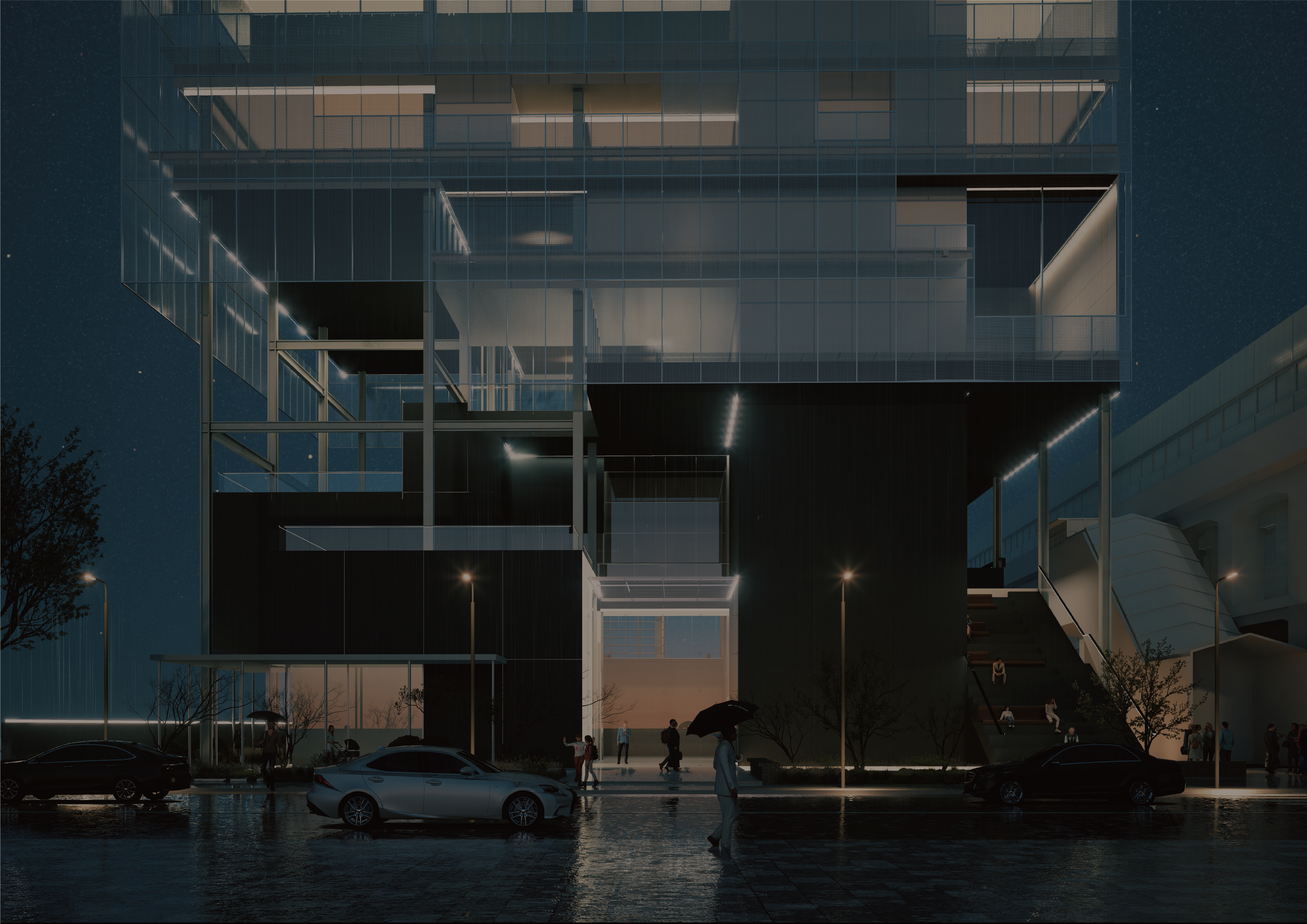
개방, 분리, 적층. 이 세 가지 키워드를 중심으로 계획하였다. 하부는 전시 프로그램을 수용하는 무거운 박스형 매스로, 상부는 오피스 프로그램을 위한 가벼운 공백의 매스로 설정하고 이를 수직적으로 연결하였다. 이를 통해 공간의 무게감과 부유감이 대비되면, 도시 맥락 안에서 건축이 시각적으로도 흥미로운 레이어를 형성한다.
The project was developed around three key concepts: openness, separation, and stacking.
The lower volume, a heavy solid box, accommodates the exhibition program, while the upper volume is conceived as a light, voided mass housing the office spaces. These two contrasting masses are vertically connected, creating a strong spatial tension between gravity and lightness. This composition forms a visually engaging architectural layer within the urban fabric, emphasizing both structural contrast and contextual responsiveness.
Design

Zooning & Program

1층은 대지 흐름에 따라 열린 형태로 구성되어 있으며, 방문자들이 자유롭게 진입할 수 있는 전시장 로비로 시작된다. 전시는 4층까지 이어지며 전시 코어를 중심으로 회전하며 상승하는 동선을 따라 전개된다. 이 과정에서 전시 관람의 몰입감이 점차 깊어진다. 5층부터 10층까지는 오피스 공간으로 쉼과 몰입이 흐름을 따라 연계되도록 계획하였다.
The first floor is designed as an open and accessible space that follows the natural pedestrian flow of the site, beginning with a public exhibition lobby that welcomes visitors in.
The exhibition unfolds up to the fourth floor, with a circulation path that spirals around a central core, gradually deepening the sense of immersion as one ascends. From the fifth to the tenth floor, the space transitions into office areas, where rest and focus are seamlessly connected along the vertical flow, continuing the spatial narrative of movement and engagement.
Drawings


2층은 1층의 전시장 홀을 내려다볼 수 있는 열린 라이브러리 및 오피스 공간으로 계획되었다. 외부 계단을 따라 올라오면 시선이 트이는 테라스로 연결되고, 이 테라스는 전시 매스를 따라 회전하며 시각적 흥미를 유도한다.
The second floor is designed as an open library and office space that overlooks the exhibition hall on the first floor, creating a sense of vertical openness and connection.
Ascending the external staircase, visitors are led to a terrace with an open view, which wraps around the exhibition mass, enhancing visual interest and spatial engagement through its dynamic form.


5층부터 상부 오피스 영역은 팀랩의 다양한 구성원들이 소통할 수 있도록 모듈화된 수평적 공간으로 구성하였고, 수직적 보이드를 통해 층간 소통과 자연채광을 유도하였다. 특히 8층에는 예술가의 창작을 위한 공용 보이드를 계획했으며, 지붕 또한 개방된 슬래브 구조로 마감하여 외부와의 연속성을 강조하였다.
From the fifth floor upward, the office spaces are organized as modular, horizontally open layouts that encourage communication among TeamLab’s diverse members. A series of vertical voids are integrated to promote inter-floor interaction and natural light penetration throughout the building. Notably, the eighth floor features a shared creative void dedicated to artistic production, while the roof is finished with an open slab structure, reinforcing the spatial continuity between interior and exterior.


Section

DETAIL DRAWINGS


Structure


건물은 Wide Flange Beam을 활용한 그리드 구조로 계획되어, 가벼운 느낌과 구조적 안정성을 동시에 확보하였다. 파사드는 하부에 무광 화이트 알루미늄 패널을 사용해 ‘채워진 박스’의 이미지를 부여했으며, 상부는 금속 메쉬로 감싸 가벼움과 투과성을 표현하였다. 이는 시간대에 따라 내부의 인상이 달라지며, 공간의 기억이 층별로 변화하는 경험을 유도한다.
유리와 메시를 지지하는 백업 시스템은 작은 Wide Flange Beam으로 구성되었으며, 슬래브와 외부 캣워크 구조 모두 철골 프레임으로 처리하여 일관된 재료감을 유지하였다.
The building adopts a grid structure using wide flange beams, achieving both a sense of lightness and structural stability. The façade is composed of matte white aluminum panels at the lower levels, emphasizing the image of a “solid box,” while the upper volumes are wrapped in metal mesh, expressing transparency and lightness. This material composition allows the building’s appearance to shift with time of day, offering a layered experience of space and memory across floors.
The backup system supporting the glass and mesh is constructed with small wide flange beams, while both the slab and external catwalks are built with steel framing, maintaining a consistent and unified material language throughout the structure.
Images


Maquette


credit