Introduction
용도 | 공간화 프로젝트
Program | Spatialization Project
Agenda

본 프로젝트는 ‘용도가 규정되지 않은 공간에서도 경계를 구획할 수 있는가?’라는 질문에서 출발하였다.
일반적으로 건축은 공간의 기능에 따라 벽과 문을 배치하고, 이를 통해 내부와 외부, 공간과 공간 사이의 경계를 명확하게 구분한다. 그러나 특정한 용도가 주어지지 않은 공간에서는 어떠한 기준으로 경계를 형성할 수 있을까?
본 프로젝트는 기능적 구획에서 벗어나 자연의 힘과 구조적 관계를 통해 새로운 경계 형성의 가능성을 탐구하고자 하였다.
This project begins with the question: “Can boundaries be defined even in spaces without a predetermined function?”
In conventional architecture, walls and doors are arranged according to the intended use of a space, clearly distinguishing between interior and exterior, as well as between different spatial zones. However, without a specific function, what determines where one space ends and another begins?
This project explores alternative ways of defining spatial boundaries through natural forces and structural relationships, moving beyond conventional functional divisions.
Research

이러한 질문을 구체화하기 위해 자연의 물리적 원리를 건축에 적용한 프라이 오토(Frei Otto)의 작품과 설계 방식을 연구하였다.
특히 바람의 흐름과 장력(Tension)이 만들어내는 구조적 형태에 주목하였다.
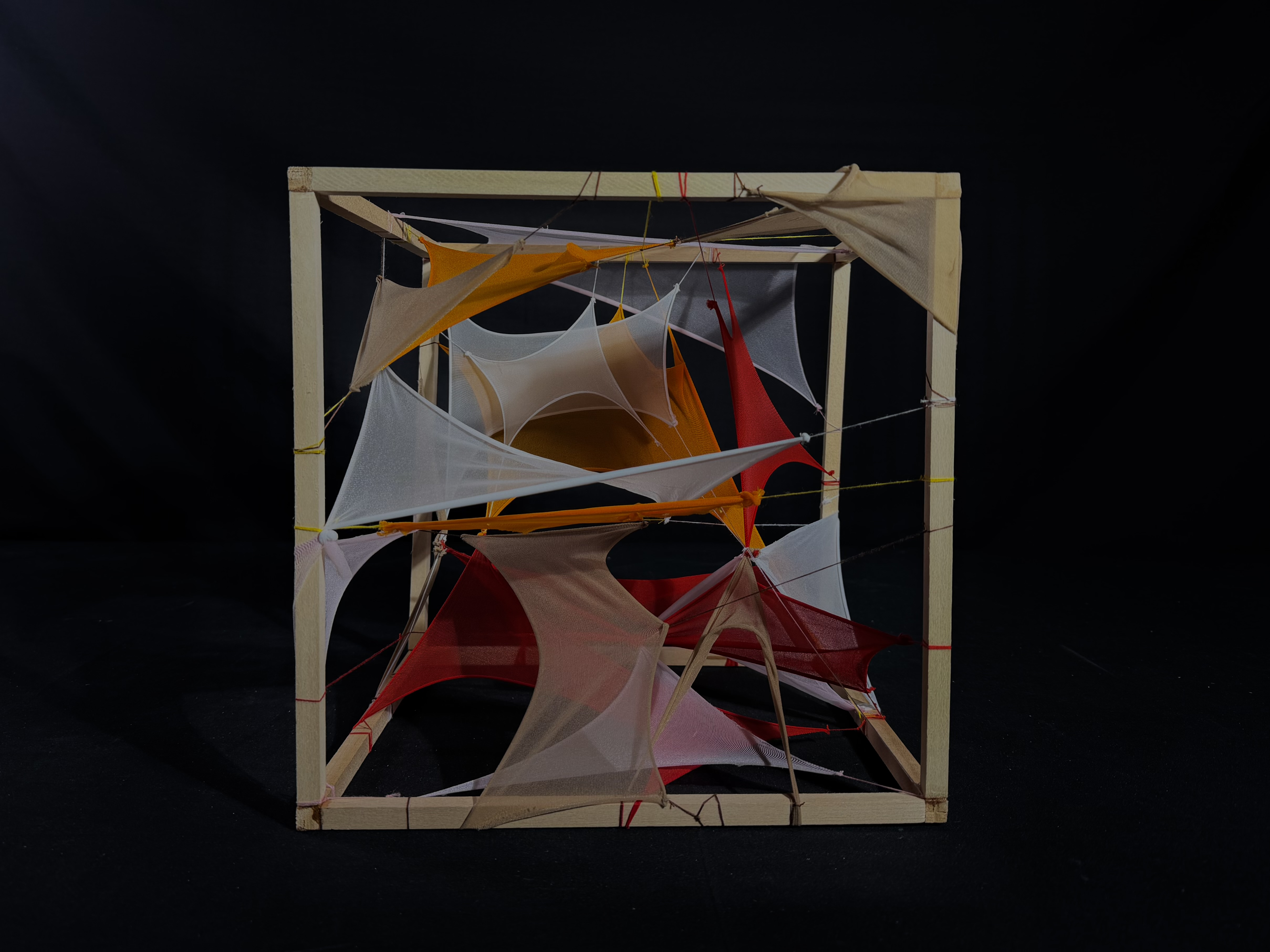
여러 방향에서 작용하는 힘의 크기와 방향에 따라 표면의 곡률과 형태가 달라지고, 이러한 변화가 물리적인 벽 없이도 공간의 영역과 경계를 형성할 수 있다는 가능성을 발견하였다.
To further investigate this question, I studied the works and design principles of Frei Otto, who applied the physical principles of nature to architectural structures.
Particular attention was given to the relationship between wind flow and tension, and how they influence structural forms.
The study revealed the potential for forces acting from multiple directions to shape surfaces and their curvature, creating spatial zones and boundaries without relying on conventional physical walls.
Study Model


연구를 통해 발견한 장력의 원리를 실제 형태로 구현하기 위해 다양한 재료를 활용한 스터디 모델을 제작하였다.
천과 실을 여러 방향으로 당기고 고정하며 힘의 방향과 고정점에 따른 표면의 곡률, 긴장감 및 형태적 변화를 관찰하였다.
또한 포맥스와 같은 단단한 재료를 함께 활용하여 유연한 구조와 견고한 구조 사이의 조형적 관계를 실험하고, 장력이 만들어내는 공간적 경계의 가능성을 구체화하였다.
To translate the principles of tension into physical forms, I developed a series of study models using various materials.
By pulling and fixing fabric and strings in different directions, I observed how the direction of forces and the placement of anchor points influenced surface curvature, structural tension, and overall form.
I also introduced rigid materials such as foam board to explore the relationship between flexible and rigid structures, further investigating how tension-based forms could establish spatial boundaries.
Design Process


스터디 모델을 통해 발견한 구조적 가능성을 바탕으로, 형태와 구조가 공간의 경계로 작용하는 방식을 발전시켰다.
물리적 힘에 의해 형성된 곡면과 표면의 방향, 밀도, 겹침을 활용하여 벽이나 문에 의존하지 않는 새로운 공간 구획 방식을 제안하고자 하였다.
Building upon the structural possibilities discovered through the study models, I developed the relationship between form, structure, and spatial boundaries.
Through variations in surface direction, density, curvature, and layering, I sought to propose an alternative method of spatial division that does not rely on conventional walls or doors.
Maquette


Credit